Teller Counters: Modular vs. Carpentry – Pros, Cons and Cost
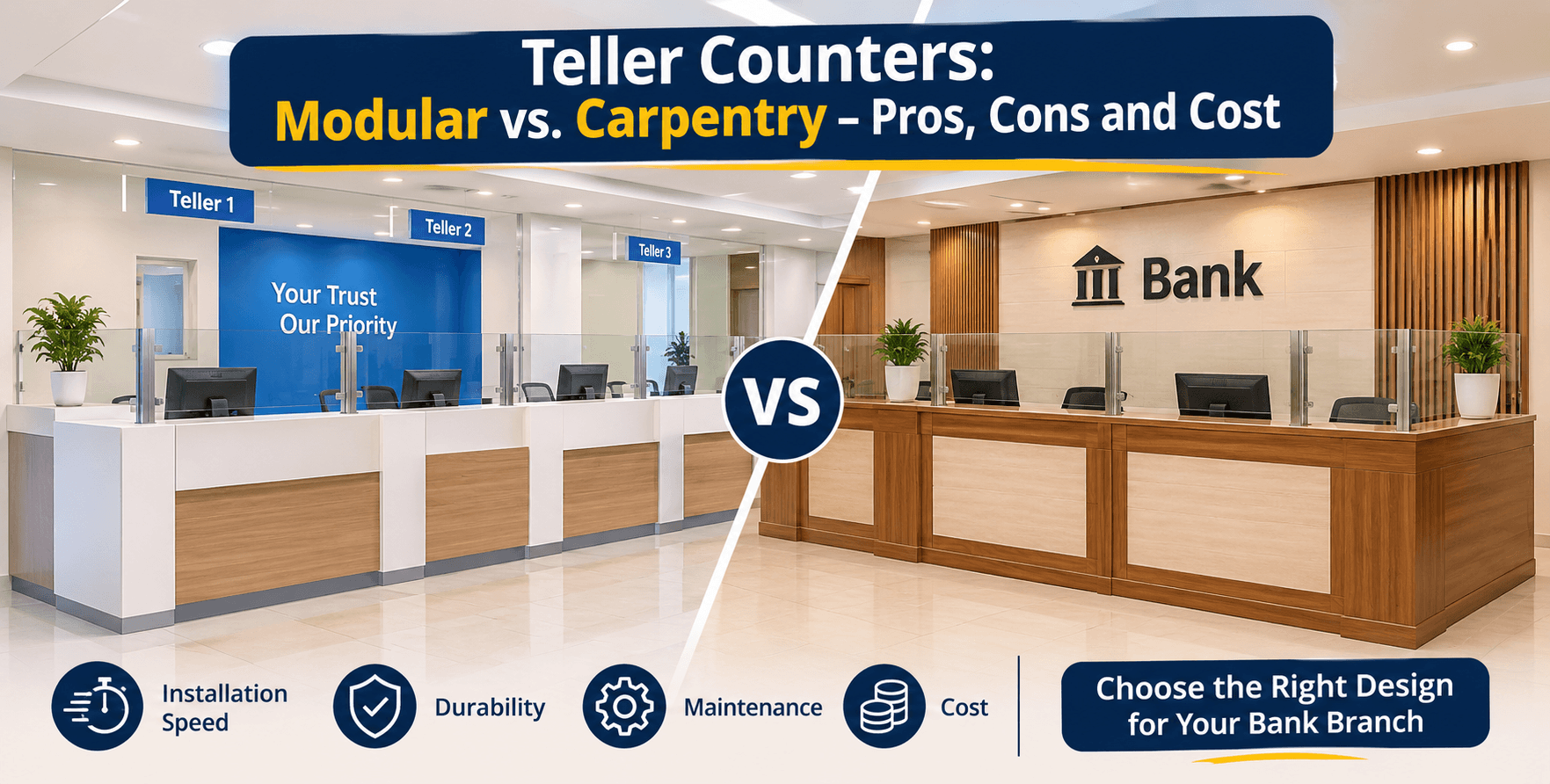
A well-designed teller counter is one of the most important elements of a bank branch. It is the primary point where customers interact with bank staff for cash deposits, withdrawals, cheque submissions, and other everyday transactions. A thoughtfully planned bank teller counter design can improve staff productivity, customer convenience, security, and the overall appearance of a branch.
When planning a new bank branch or renovating an existing one, banks generally consider two options: modular teller counters and traditional carpentry-based counters. Both have their own advantages, limitations, and cost considerations. Understanding these differences helps banks select a solution that meets their operational requirements and budget.
What Is a Modular Teller Counter?
A modular teller counter is a prefabricated workstation manufactured using standardized components. It is designed to accommodate computers, cash drawers, storage units, cable management systems, and other banking equipment.
These counters are generally manufactured in controlled conditions and assembled at the branch location. Their modular structure makes them suitable for banks that want consistent designs across multiple branches.
Advantages of Modular Teller Counters
Faster Installation: Since most components are manufactured in advance, installation at the branch is generally quicker.
Consistent Appearance: Standardized designs help maintain uniformity across different bank branches.
Easy Maintenance: Individual components can often be repaired or replaced without rebuilding the entire counter.
Better Space Planning: Modular layouts can be customized to accommodate equipment, storage, and staff movement.
Modern Finish: They offer a professional appearance with organized workspaces and integrated cable management.
Disadvantages of Modular Teller Counters
Initial manufacturing costs may be higher depending on materials and specifications.
Custom dimensions or unusual branch layouts may require additional modifications.
What Is a Traditional Carpentry Teller Counter?
A carpentry-based teller counter is built on-site by skilled carpenters using materials such as plywood, laminates, MDF, and other suitable boards. Its dimensions and design can be adjusted according to the available space and the specific requirements of the bank.
This option is often considered for renovation projects, older branches, or locations where standard modular dimensions are not practical.
Advantages of Carpentry Teller Counters
Flexible Design: Counters can be built according to the exact dimensions and layout of the branch.
Material Choices: Banks can select different boards, laminates, finishes, and hardware based on their requirements.
Suitable for Renovation: Existing structures and irregular spaces can be accommodated more easily.
Local Repairs: Minor repairs and adjustments can often be handled by local carpentry teams.
Disadvantages of Carpentry Teller Counters
On-site construction may take longer, depending on the complexity of the design.
Maintaining identical finishes across multiple branches can be challenging.
Quality depends significantly on workmanship and material selection.
Future modifications may require additional carpentry work.
Modular vs. Carpentry Teller Counters: Cost Comparison
The cost of a teller counter depends on several factors, including its dimensions, number of workstations, material quality, laminate finish, hardware, storage requirements, and installation complexity.
Modular counters may involve higher initial manufacturing and transportation costs, but standardized production can make them efficient for projects involving multiple branches.
Carpentry counters may offer flexibility in material selection and local execution. However, the final cost can increase if the design requires complex detailing, additional finishing, or repeated modifications.
Instead of comparing only the initial price, banks should also consider maintenance, durability, replacement costs, and long-term usability.
Which Teller Counter Is Better for Your Bank?
The right choice depends on the branch layout, budget, project timeline, and operational requirements.
Choose modular counters when uniformity, faster installation, and standardized branch layouts are important.
Choose carpentry counters when the branch has unusual dimensions, renovation restrictions, or highly specific design requirements.
In some projects, a combination of modular components and customized carpentry can also provide a practical solution.
Important Factors to Consider Before Finalizing the Design
Before selecting a teller counter, banks should evaluate staff comfort, customer accessibility, cash-handling security, storage requirements, electrical points, cable management, and the overall branch workflow.
The counter height, working depth, privacy arrangements, and accessibility should be planned carefully. Security-related features should also follow the bank's operational policies and applicable safety requirements.
Conclusion
Both modular and carpentry teller counters can work effectively when designed according to the needs of a bank branch. Modular counters are suitable for standardized and repeatable projects, while carpentry counters offer greater flexibility for customized spaces.
A successful bank teller counter design should balance functionality, security, durability, appearance, and long-term maintenance rather than focusing only on the initial installation cost.
For professional bank branch interior planning, explore Bhavya Enterprises' Bank Branch Interior Solutions and choose a design approach that supports efficient banking operations.